The ACCESS Framework™
An Instructional Design System for Special Education

What is the ACCESS Framework™ ?
The ACCESS Framework™ is an instructional design framework created to help special education teachers plan lessons that are clear, accessible, and intentional.
ACCESS does not replace curriculum.
ACCESS provides a lens for how instruction is designed, delivered, and supported.
It works alongside any alternate or specialized curriculum and helps teachers:
-
prioritize what matters most
-
reduce instructional overload
-
increase student access and participation
-
plan lessons with clarity and confidence
What ACCESS Stands For

Aligned
Clear instructional purpose
Teachers can clearly state:
-
what students are learning
-
why they are learning it
Instruction focuses on one primary goal, even when multiple activities support it.
Chunked
Small, intentional steps
Instruction is broken into manageable parts so students are not asked to:
-
process multiple demands at once
-
listen, read, write, and respond simultaneously
Chunking reduces cognitive load and increases success.
Concrete → Abstract
Experience before expression
Students access ideas first through:
-
visuals
-
objects
-
demonstrations
-
real-life examples
Abstract responses (spoken words, symbols, writing) come after access, not before.
Explicit
Modeled and named instruction
Skills are:
-
clearly named
-
directly modeled
-
intentionally practiced
Students are not expected to infer, guess, or “just know” what to do.
Supported
Built-in instructional supports
Supports are embedded into instruction so students can participate meaningfully.
Common supports include:
-
Visual supports: picture choices, icons, highlighted text, visual schedules
-
Prompting supports: verbal prompts, gestural prompts, modeling
-
Communication supports: AAC systems, choice boards, pointing
-
Tools: timers, checklists, sentence frames, guided response options
If only verbal students can respond, supports are missing.
Scaffolded for Success
Supports that fade over time
Scaffolds are temporary supports that change as students gain independence.
Common scaffolds include:
-
errorless learning
-
reduced answer choices
-
modeling and guided practice
-
physical, verbal, or visual prompts
Over time, scaffolds fade by:
-
increasing answer choices
-
reducing prompts
-
removing visual cues
-
shifting responsibility to the student
Scaffolds are designed to lead to independence, not dependence.
What ACCESS Looks Like in Practice

ACCESS is Curriculum-Agnostic
ACCESS is curriculum-agnostic.
-
ACCESS Framework: how instruction is structured, scaffolded, and delivered
-
Curriculum: what content, themes, and materials are used
ACCESS works alongside any alternate or specialized curriculum and strengthens how that curriculum is implemented.

How ACCESS Helps You Prioritize Instruction
One of the biggest challenges in special education is curriculum overload.
ACCESS helps teachers decide:
-
What must be taught deeply
-
What should be introduced for exposure
-
What can be revisited over time
This prevents overwhelm while still honoring access.
Core instruction focuses on skills taught with intention, repetition, and data collection.
Exposure instruction introduces skills without pressure for mastery.
Both are intentional.
Both matter.

Why Teachers Use ACCESS
Teachers use ACCESS because it:
-
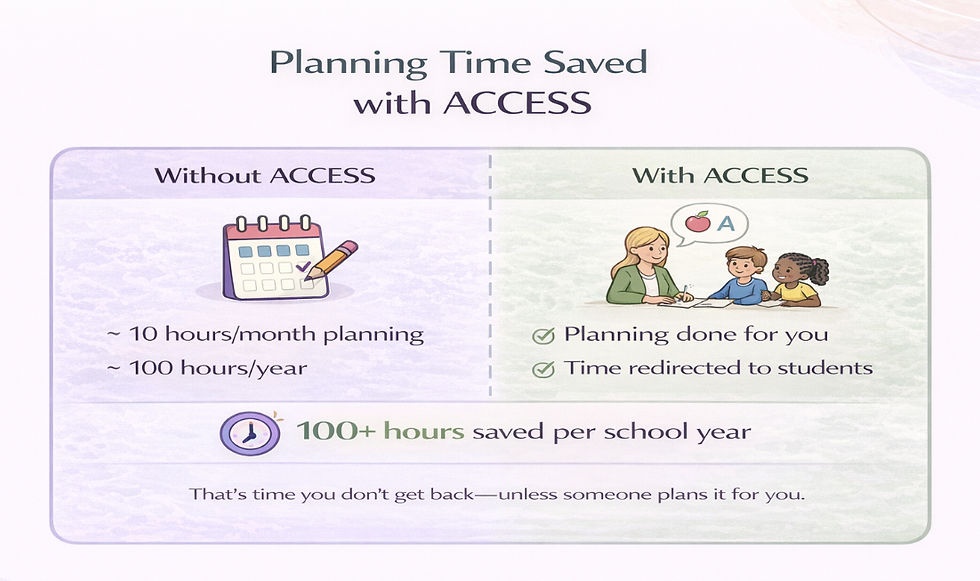
reduces planning overwhelm
-
provides structure without rigidity
-
validates effective instructional practices
-
saves time by clarifying what to prioritize
ACCESS helps teachers focus on teaching, not constantly re-planning.